How to pack a duffel or weekender bag
Shoes first, weight low and central, soft clothes rolled, dressy clothes on top. The 9-step method, a packing map, and lists for a weekend and a week.
To pack a duffel bag well, put shoes in their own compartment or at the bottom, place heavy items low and in the center, roll soft clothes around them, and lay a folded or hanging layer of dressier clothes on top. Keep liquids, chargers and documents in the last spots you pack so you can reach them first. Done in that order, a soft bag carries more, holds its shape and keeps your outfit for tomorrow near the zipper.
Below is the full method in nine steps, a packing map you can copy, lists for a weekend and a week, and how to carry the bag once it is full. It works for any duffel bag or weekender bag, and we show where our own bag’s suit section and shoe compartment fit in.
How to pack a duffel bag in 9 steps
A duffel bag has no rigid frame, so the way you load it decides its shape. The goal is a flat, even base, a dense middle and a light top. Follow these steps in order.
- Lay everything out on the bed and remove a third of it.
- Pack shoes first, in a shoe compartment or in bags at the bottom.
- Put heavy, solid items low and in the middle.
- Roll t-shirts, knitwear, sleepwear and workout clothes.
- Fold or hang the clothes that wrinkle.
- Fill every gap with socks, underwear and belts.
- Pack toiletries in one pouch near the top.
- Put tomorrow’s outfit on the very top.
- Load documents, phone, chargers and keys into the outside pocket.
1. Edit before you pack
Plan outfits, not items. Pick one color family, then count tops and bottoms against the number of days. Two pairs of shoes cover most trips: one you wear and one you pack. Everything you take out at this stage is space you get back for the trip home.
2. Shoes go in first
Shoes are the heaviest and dirtiest things in most duffel bags. If your duffel bag has a separate shoe compartment, use it, because it keeps soles away from shirts and gives the main section a flat floor. Without one, put each pair in a shoe bag or a shower cap and lay them heel to toe along the base, soles facing the side wall.
3. Heavy and bulky items low and central
Jeans, a sweater, a hair dryer or a book belong in the middle of the base, between the shoes. Weight in the center stops a duffel bag from tipping when you set it down and keeps it from swinging against your hip. Avoid stacking heavy items at one end.
4. Roll the soft layer
Roll t-shirts, leggings, pajamas and gym clothes tightly and line them up like logs across the width of the duffel bag. Rolling suits stretchy, casual fabrics. It also lets you see every item at a glance, so you are not digging through folded stacks.
5. Fold or hang anything that creases
Dress shirts, blazers, trousers and dresses wrinkle when they are squeezed into a rounded bag. Fold them flat around a soft core, or hang them if your bag has a garment section. Our guide on how to pack clothes without wrinkles covers the folding methods side by side.
6. Fill the gaps
Push socks and underwear into shoes and into the corners. Coil belts around the inside wall. A full, evenly packed bag holds its shape better than a half-empty one, and soft fillers protect anything fragile.
7. Toiletries in one pouch near the top
Keep all liquids in one clear pouch so a leak stays contained and security screening is quick. If you fly with the bag as a carry-on, the TSA liquids rule limits each container to 3.4 ounces (100 milliliters), and they must fit in one quart-size bag (checked November 2026).
8. Tomorrow’s outfit on top
Lay the first outfit you will wear across the top of the duffel bag. You can dress on arrival without unpacking, and the rest of the load stays in place.
9. The outside pocket is for the things you reach for
Passport, boarding pass, phone, charger, earbuds, keys and medication go in the outside pocket. Nothing you need in a queue or on the plane should sit under clothes.
A packing map for a duffel bag or weekender bag
Use this map to decide where each item goes. It applies to a classic duffel bag with one big compartment and to a weekender bag with extra sections.
| Zone | What goes there | Why |
|---|---|---|
| Shoe compartment or base | Shoes in bags, sneakers, sandals | Keeps dirt off clothes and gives a flat floor |
| Center of the base | Jeans, sweaters, a hair dryer, books | Weight stays low and balanced |
| Middle layer | Rolled t-shirts, sleepwear, gym clothes | Rolls fill space and are easy to see |
| Top layer or garment section | Shirts, blazer, trousers, dress, suit | Less pressure means fewer creases |
| Corners and inside shoes | Socks, underwear, belts, chargers | Fills dead space so the bag keeps its shape |
| Top, under the zipper | Toiletry pouch, tomorrow’s outfit | Out first at security and at the hotel |
| Outside pocket | Passport, phone, keys, medication | Reachable without opening the main zip |
How to pack a suit or dress in a duffel bag
A suit is the hardest item to pack in a soft bag. You have two options: fold it, or hang it in a bag that has a garment section.
To fold a jacket, turn one shoulder inside out, tuck the other shoulder into it, fold the jacket in half lengthwise and then once across. Lay it on top of a soft layer of rolled clothes, never under shoes. Trousers fold along the crease and lie flat beneath it. Our step-by-step guide on how to pack a suit in a carry-on has photos of each fold.
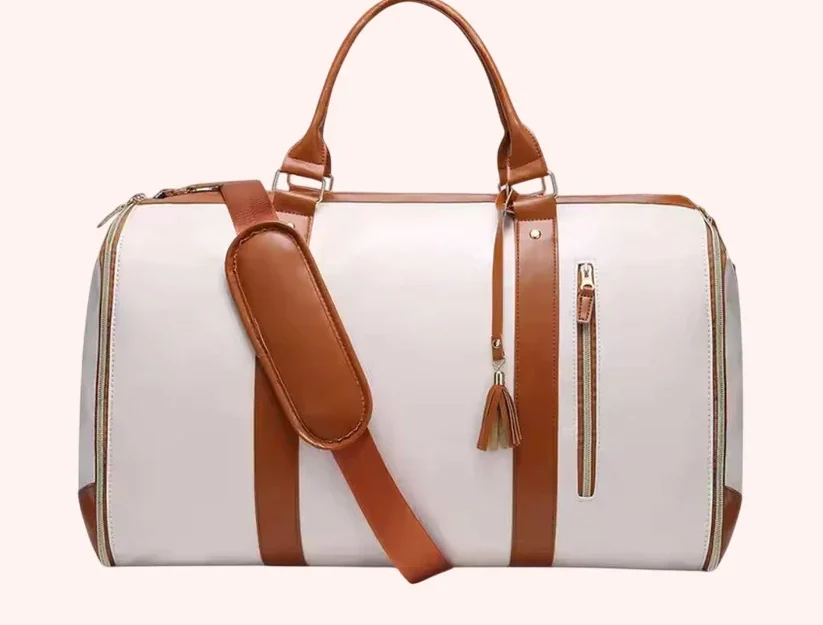
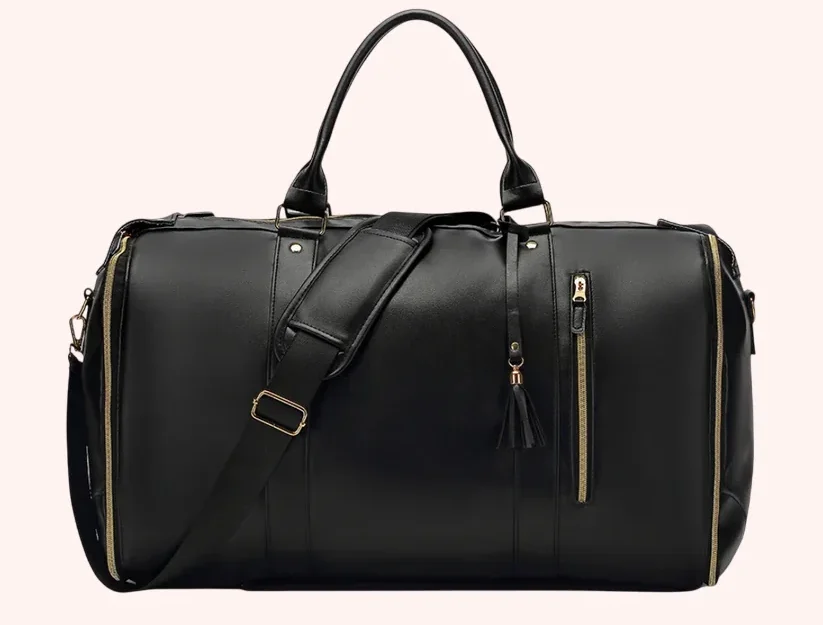
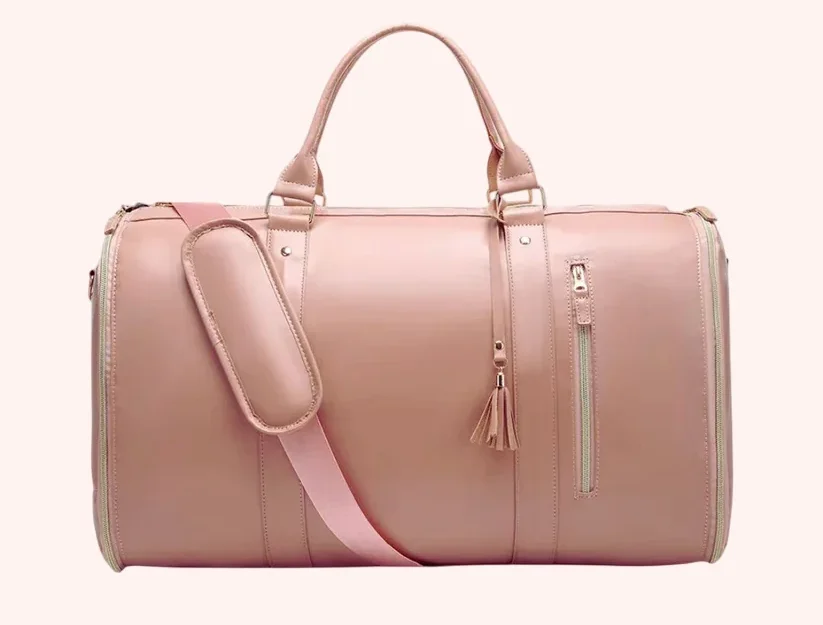
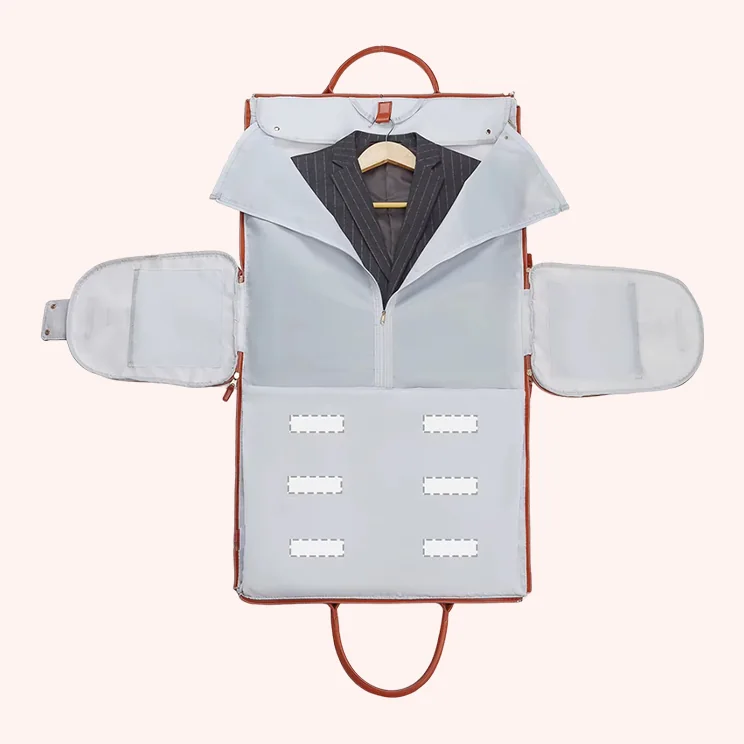
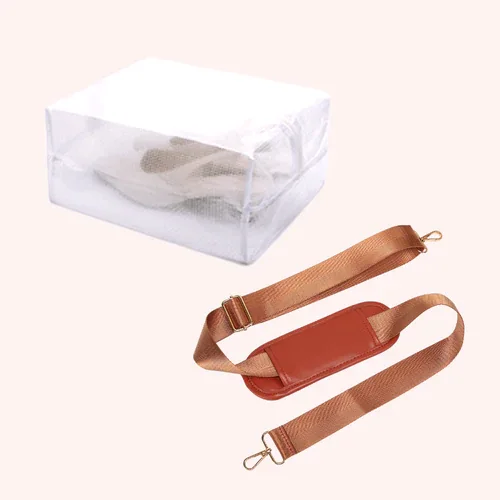
The other option is a garment duffel. We designed the PristineBag Travel Duffel for exactly this: it opens flat into a garment bag with a hanging section for one suit or dress. You hang the suit, fold the sides in and zip, and the bag closes into a duffel. Shoes go in the separate shoe compartment, so they never touch the jacket. For dresses, see how to pack a dress without wrinkles.
- Button the jacket and hang it on a slim hanger.
- Hang the trousers on the same hanger, folded over the bar.
- Place a shirt over the jacket so it lies flat against the lining.
- Fold the sides in, zip, and pack the rest of your clothes into the main section.
How to pack a duffel bag for a week
A week fits in a 60 L duffel bag if you plan to wear things twice. Most people overpack tops and underpack layers. Here is a list that fits into one bag with room for a suit or dress. Our own bag holds about 42 L, which is sized for a weekend or 2 to 3 nights, so for a full week this list needs a larger bag or a lot of rewearing.
- Tops: 5 to 6, at least two that work dressed up.
- Bottoms: 2 to 3, one dark pair of trousers or a skirt that goes with every top.
- Layer: 1 sweater or light jacket, worn on travel day.
- Underwear and socks: 7 of each, or 4 if you can wash in the sink.
- Shoes: 2 pairs, one worn and one packed.
- Sleepwear and gym kit: one set each.
- Formal outfit: one suit or dress, hung or folded on top.
- Toiletries: one pouch, travel sizes.
Wear the bulkiest shoes and jacket on travel day. They are the items that take the most room in a bag. For more detail, read how to pack a carry-on for a week, which uses the same capsule approach.
Packing a weekender bag for two or three nights
A weekend needs less than you think. Two outfits plus one for the evening, one pair of extra shoes, sleepwear and a toiletry pouch fit easily in a weekender bag of 30 to 45 L, and leave space in a 60 L weekender bag for a jacket or shopping. Our own bag holds about 42 L, so it sits in this range, with a suit or dress in the garment section and dress shoes in the shoe compartment.
Pack it in the same order: shoes, heavy items, rolled clothes, then the dressier layer on top. Our weekend trip packing list is a checklist you can tick off, and the overnight bag packing list covers one-night trips.
Packing a carry-on duffel: size and liquids
If the bag goes in the overhead bin, check its packed size against the airline’s limit, not the size printed on the tag. A soft duffel bag gets deeper as you fill it.
American, Delta and United list a carry-on limit of 22 × 14 × 9 in (56 × 35 or 36 × 23 cm), including handles and wheels (American Airlines carry-on rules, checked November 2026). Frontier allows 24 × 16 × 10 in. Rules change, so confirm with your airline before you fly.
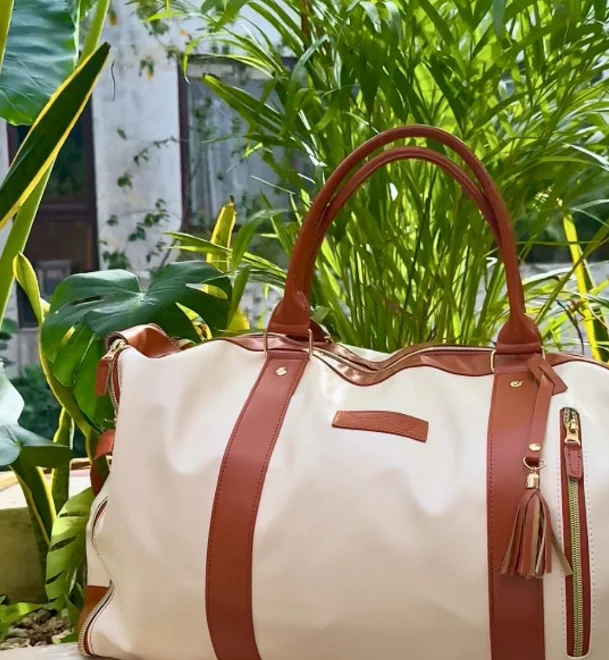
Our own bag is 20.5 × 12.5 × 10 in (52 × 32 × 25 cm) when packed full. That is about 1 in over the 9 in depth limit used by most large US airlines, and within the 10 in limit at Southwest and Frontier on paper. A soft bag that is not packed full compresses, but we have not measured by how much. Use the fit checker on our carry-on size page to compare your bag with each airline, and read can a duffel bag be a carry-on for the full answer.
- Pack the bag, zip it, then measure the deepest point.
- Keep the bag below full if you are close to the limit.
- Move the toiletry pouch and laptop to your personal item to slim it down.
How to carry a duffel bag comfortably
How you carry a full duffel bag matters as much as how you pack it. A 60 L bag full of clothes and shoes is heavy, so spread the load.
- Use the shoulder strap for long walks. Wear it across the body so the bag rests on your hip, not your lower back.
- Use the top handles for short distances. Hold both handles together so the bag hangs level.
- Slide it over a suitcase handle. A trolley sleeve lets the duffel ride on top of a rolling suitcase through the airport.
- Keep the heavy items centered. A bag packed heavy at one end swings and pulls on the strap.

Mistakes that make a duffel bag messy
- Packing shoes on top. They crush shirts and shift every time you lift the bag.
- Leaving empty space. A half-full duffel bag slumps, and clothes slide into a pile at one end.
- Folding everything. Folded stacks collapse in a soft bag. Roll the casual clothes and fold only what creases.
- Burying documents. If you have to open the main zipper at security, the top layer falls apart.
- Forgetting the trip home. Leave a little room, or pack a foldable tote for anything you buy.
FAQ about packing a duffel
Is it better to roll or fold clothes in a duffel bag?
Roll casual and stretchy clothes, and fold or hang anything that creases, such as dress shirts, blazers and trousers. Rolls fill the rounded shape of a duffel, while flat folds sit best on top where there is less pressure.
How many days can you pack in a 60 L duffel?
A 60 L bag holds about 5 to 7 days of clothes if you rewear trousers and layers, and 3 to 4 days if you also bring a suit and a second pair of dress shoes. Our own bag holds about 42 L, which suits a weekend or a 2 to 3 night trip with a suit or dress. See our guide to duffel bag sizes for other capacities.
Where should shoes go in a weekender bag?
In a shoe compartment if the bag has one. If not, put each pair in a bag and lay them along the base, soles against the side wall, with socks stuffed inside.
How do I stop a duffel bag from losing its shape?
Pack it full and evenly. Create a flat base with shoes or a folded sweater, keep the weight in the middle and fill corners with soft items. A bag that is half empty is the one that slumps.
Keep reading
More on weekender and duffel bags