PU leather vs real leather for travel bags
Real leather is stronger and can last decades. PU leather costs less, sheds rain and wipes clean, but cannot be restored once it peels. Nine differences that matter for a travel bag.
PU leather vs real leather comes down to this: real leather is tanned animal hide, and PU leather is a fabric coated with polyurethane and embossed to look like hide. Real leather is stronger, breathes better and can age well for decades with care. PU leather costs less, shrugs off rain better, wipes clean in seconds and needs no conditioning, but its coating cannot be restored once it starts to crack or peel.
We make the PristineBag Travel Duffel, so we have a stake in this. Our bag has a water-resistant PU finish, and we will tell you plainly where that is the better choice for a travel bag and where real leather wins.
PU leather vs real leather at a glance
The table sums up nine differences that matter for a bag you carry through airports, hotel lobbies and car trunks. The sections below explain each one and where the numbers come from.
| Difference | PU leather | Real leather |
|---|---|---|
| Strength | Lower tear and tensile strength in lab tests | Much higher tear and tensile strength |
| Rain and spills | Sheds water well; seams and zips still leak | Absorbs water; can spot or stiffen if soaked |
| Breathability | Low | High |
| How it ages | Looks the same for years, then can crack or peel | Darkens and softens; scuffs can often be buffed out |
| Care | Damp cloth, mild soap, air dry | Dust, clean gently, condition now and then |
| Repair | Peeled coating cannot be restored | Can be cleaned, conditioned, recolored and stitched |
| Price | Usually lower | Usually higher, especially full grain |
| Weight and feel | Depends on the build; smooth, cooler touch | Depends on the build; warmer, natural touch |
| Animal products | None in the coated fabric itself | Yes |
Keep one thing in mind: both words cover a wide range of quality. A well-made PU may hold up better than a thin, heavily coated split leather, while a good full-grain hide is the toughest of the lot. Compare specific bags, not just the material names.
What PU leather is
PU stands for polyurethane, a plastic made by reacting two families of chemicals, diisocyanates and polyols, as the American Chemistry Council explains. In PU leather, that polymer is applied in layers over a textile.
A 2021 study by the FILK Freiberg Institute in Germany describes the typical build: a textile support, a foamed middle layer, a compact layer and a thin topcoat. The grain you see is embossed into the surface. The backing is often polyester, which makes the whole material fossil-based, according to the study in the journal Coatings.
You will see the same material sold as faux leather, vegan leather, synthetic leather, leatherette or pleather. Some of those names also cover PVC (vinyl), which is a different plastic. If a label just says “vegan leather”, the fiber content tag tells you which one it is.
What real leather is, and what “genuine leather” means
Real leather is animal skin, usually cowhide for bags, that has been tanned so it stops rotting and stays flexible. Its strength comes from a dense, woven network of collagen fibers that gets tighter toward the surface.
Leather comes in grades, and the label tells you a lot:
- Full grain: the outer surface of the hide with its natural grain left on. The strongest and most expensive grade.
- Top grain: the outer layer, sanded or corrected to even out marks, then finished.
- Split leather: the lower layers left after the top is split off. Often coated and embossed to look like grain leather.
- Bonded leather: leather scraps ground up and held together with binders.
“Genuine leather” is not a grade. It only tells you the material is real hide, not which layer it came from. When you compare genuine leather vs PU leather, a split leather with a thick finish can feel and behave a lot like a coated fabric.
US rules back this up. Under the FTC’s Guides for Select Leather and Imitation Leather Products, a seller should not call something leather unless it is leather in all substantial parts. Materials that look like leather but are not should be disclosed with words such as “imitation leather”, “not leather” or “vinyl”. Bonded leather should state its percentage of leather fibers.
The nine differences in detail
Strength and durability
Real leather is much stronger. In the FILK study, a full-grain shoe leather had a tear resistance of 82.9 N/mm, while the PU-coated textile used as a reference measured 17 N/mm, about a fifth as much. Tensile strength showed the same pattern: 39.5 against 10.2 N/mm².
Flexing is a different story. The PU-coated textile lasted 200,000 bending cycles before small cracks showed in its topcoat, and the leather went past 200,000 without reaching that point. Both beat the 80,000 cycles required for shoe uppers under ISO 20942. So a decent PU will not crack from ordinary folding, but it tears more easily if it snags on a sharp edge.
Two cautions. The study tested one sample of each material, and all samples were supplied by the German Leather Association. Treat the numbers as an example of the gap, not a rule for every bag.
Rain and spills
This is where PU leather wins. Coated materials are tight against water, and the FILK authors note they would keep out rain if used for a bag. Leather absorbs water: the leather sample took up about six times more water vapor than the PU-coated textile.
A water-resistant surface does not make a bag waterproof, though. Water gets in through stitching and zips. Under the FTC guides, a product should only be called waterproof if it keeps water from its contents under normal use for its whole expected life (see 16 CFR 24.3).
Breathability
Real leather breathes. In the same study, the leather let through about four times more water vapor than the PU-coated textile. For shoes and jackets this matters a lot. For a duffel it matters less, but a damp PU bag that is zipped shut dries slowly, so air it out after a wet trip.
How each material ages
Real leather darkens, softens and picks up marks that many owners like. Light scuffs on full-grain leather can often be rubbed or conditioned out.
PU leather looks much the same for years, then can fail all at once. The Fashion Museum Antwerp’s damage atlas for polyurethanes lists flaking caused by hydrolysis, a slow reaction with moisture, and notes that light and heat also break the polymer down. Ester-based polyurethanes are more sensitive to moisture than ether-based ones.
Care and cleaning
PU leather is the easy one. Wipe it with a damp cloth, use a drop of mild soap for marks, and let it air dry. No conditioner, no special kit.
Real leather needs more attention. Keep it out of soaking rain, let it dry slowly away from heaters, and condition it now and then so it does not dry out and crack. Our bag care guides go through both in more detail.
Repair
A good leather repairer can clean, recolor, condition and restitch real leather, so a quality leather bag can be kept going for a long time. Once a PU coating separates from its backing, there is no way to make it whole again. The Drycleaning & Laundry Institute says the same about polyurethane coatings that separate after dry cleaning: no method of restoration. Touch-up products can hide small spots, but they do not rebuild the layer.
Price
PU leather is usually cheaper. The FILK authors point out that synthetic materials can be made as continuous rolls on industrial lines, which helped them win on price. Full-grain leather is the most expensive option, and the gap shows up in the final price of a bag.
Weight and feel
Weight depends more on a bag’s build than on the surface, so compare the listed empty weights. Leather feels warmer and more natural in the hand. PU can feel slightly smooth or plastic up close, and the FILK panel described the coated samples as soft but with an artificial, slightly sticky touch.
Animal products and the environment
PU-coated fabric contains no animal hide, which is why it is sold as vegan leather. It is a plastic, though, usually made from fossil raw materials. Leather comes from cattle, and cattle farming is criticized for its greenhouse gas emissions. Neither is a clean win.
Which is better for a travel bag?
Choose real leather if you want a bag that can last for decades, you are happy to condition it, and you do not mind extra cost or keeping it out of heavy rain. Full grain is the grade to pay for.
Choose PU leather if you want a lower price, a surface that wipes clean, no conditioning, and no animal products. Accept that it will not develop a patina and that a peeling coating is the end of the surface, not a repair job.
For travel in particular, a few practical points tip the scale:
- Overhead bins, car trunks and airport floors scuff everything. Leather hides scuffs better over time; PU shows deep scratches.
- Wet taxi lines and sudden showers are easier on PU.
- Weekend trips with a suit and shoes need structure and compartments more than a premium hide. See what makes a good weekender bag.
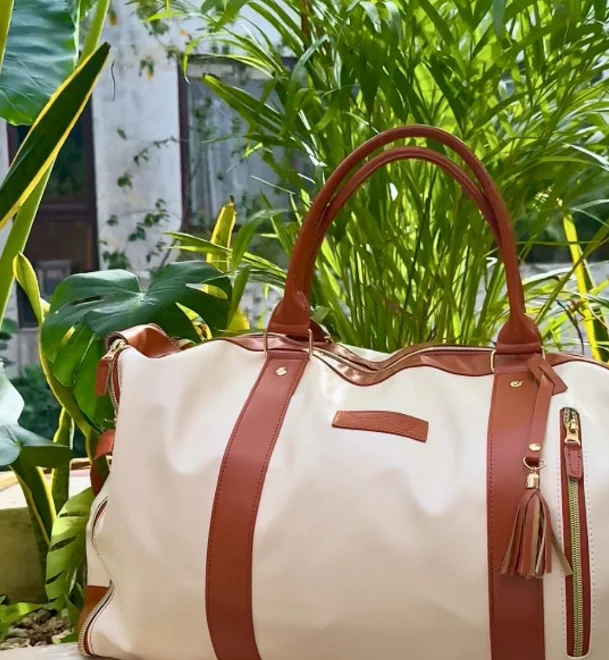
Our bag: what a PU finish can and cannot do
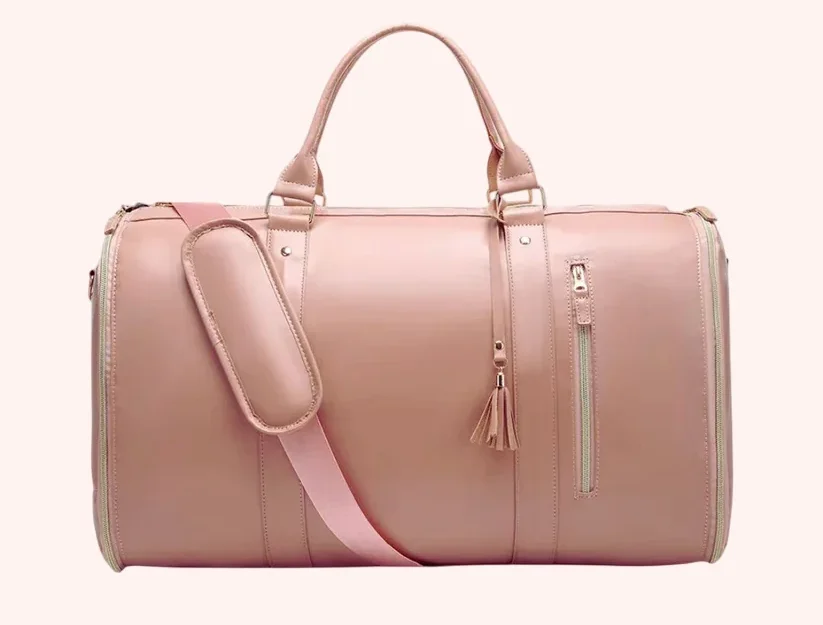
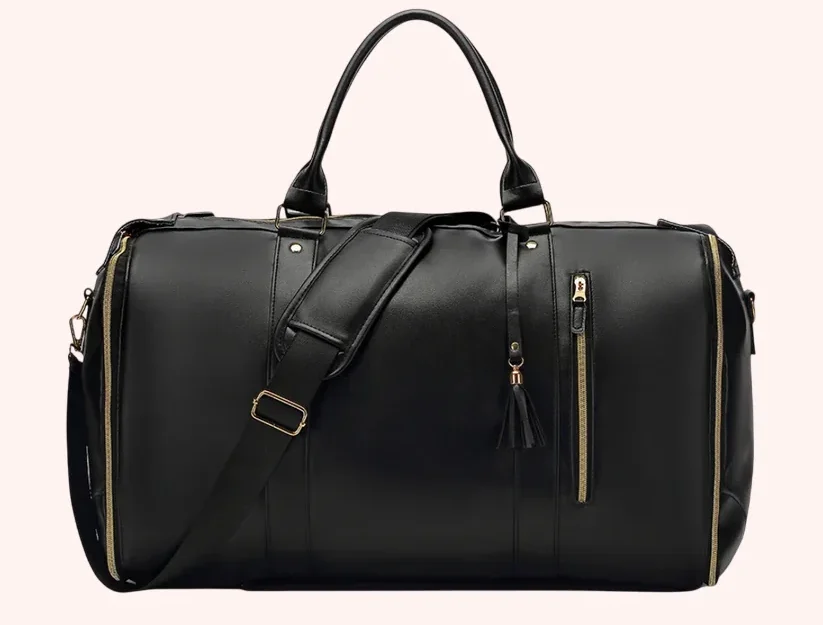
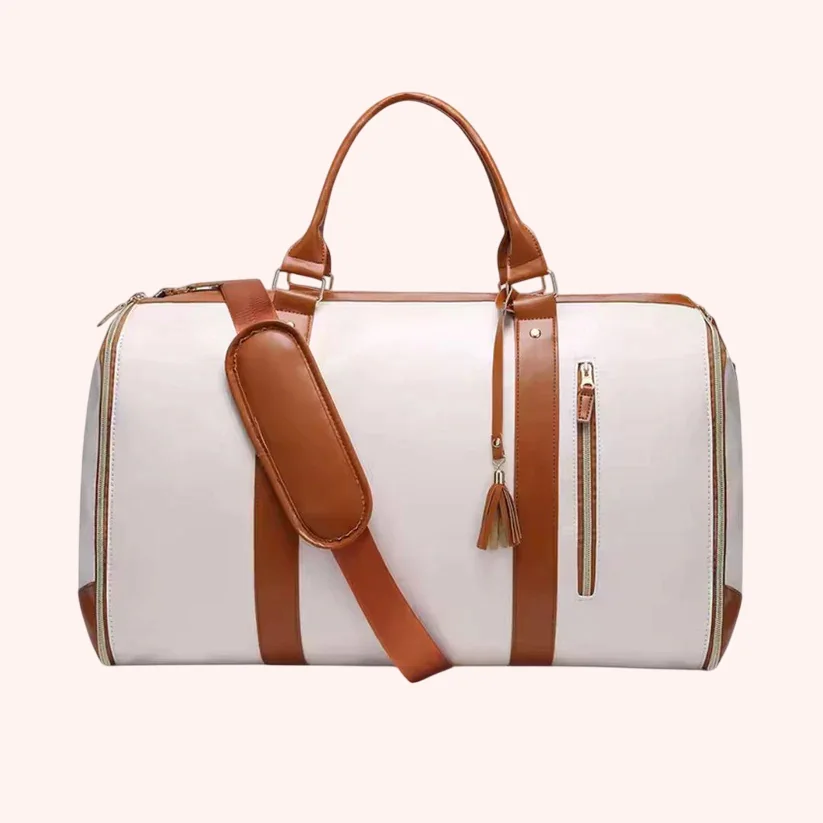
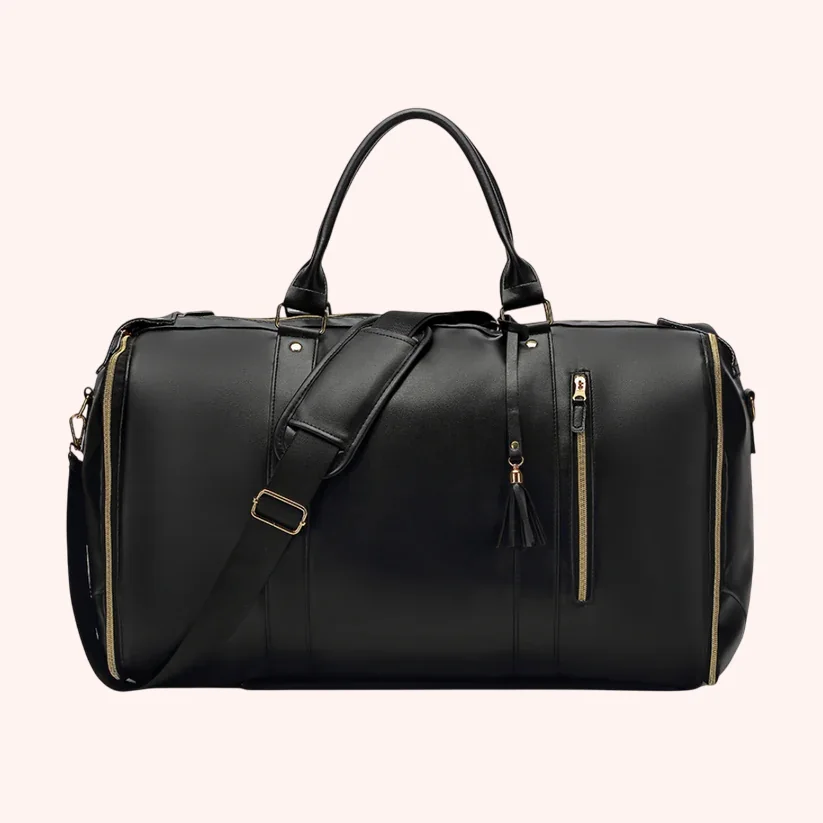
The PristineBag Travel Duffel has a water-resistant PU finish with a vegan leather look. It is not waterproof, so a heavy downpour will find its way through the zips and seams. Clean it with a damp cloth and let it air dry. It does not go in the washing machine.
We chose PU for a travel bag because it wipes clean after a day of airports and needs no conditioning. The bag weighs about 2.4 lb (1.1 kg) empty, according to our supplier’s spec, and comes in Beige, Black and Pink for $159.
The honest trade-offs: it is not leather, it will not age into a patina, and like any PU it should be kept away from heat, long direct sun and damp storage. We cannot promise any coated material will never peel, and we will not pretend otherwise.
What the bag is designed to do is the part we care most about: it opens flat into a garment bag for one suit or dress, has a separate shoe compartment, and slides over a suitcase handle with its trolley sleeve. Packed full it measures 20.5 × 12.5 × 10 in (52 × 32 × 25 cm), which is about 1 in deeper than the 22 × 14 × 9 in limit at most large US airlines. Check your route with our carry-on size checker before you fly.
How to tell PU leather from real leather in a shop
You do not need a lab to spot the difference. Start with the label, then look closely.
- Read the tag. In the US, imitation leather should be disclosed. Look for words like “polyurethane”, “PU”, “vinyl”, “imitation” or “man-made materials”.
- Look at the grain. Real hide has irregular pores and creases. Embossed PU often repeats the same pattern across a panel.
- Check a cut edge or the inside of a seam. Leather shows a fibrous edge. PU shows a thin coating over woven or knitted fabric.
- Press it. Leather wrinkles and gathers softly under your thumb. PU tends to dimple and spring back.
- Feel the temperature. Leather warms up in your hand. Coated fabric stays cooler and smoother.
Skip the “burn test” you may read about online. It damages the bag and tells you little that the label does not.

Caring for each material on the road
Whatever you choose, how you dry and store the bag matters as much as how you use it. A few habits help both materials:
- Empty the bag after each trip and let it air out with the zips open.
- Dry it at room temperature. Never use a hair dryer, radiator or tumble dryer.
- Store it in a cool, dry closet, stuffed lightly so it keeps its shape, not in a hot attic or damp basement.
- Keep pens, perfume and hand sanitizer in a pouch. Ink and alcohol mark both surfaces.
- Pack shoes in a separate compartment or bag so soles do not rub the lining. Our guide to packing a duffel bag shows a simple order that protects the outside too.
If you are still deciding on size before material, our breakdown of duffel bag sizes from 30L to 60L will help you narrow it down first.
PU leather vs real leather: common questions
Is PU leather real leather?
No. Standard PU leather is a fabric coated with polyurethane, with no animal hide in it. Some products use a split-leather backing under a PU coat, and those count as leather-based, so read the label.
Is genuine leather better than PU leather?
Usually, but not always. Genuine leather means real hide of any grade, and low grades are often heavily coated. A full-grain leather beats PU on strength and lifespan; a thin coated split may not beat a well-made PU by much.
Does PU leather last as long as real leather?
Generally not. Leather can be conditioned and repaired for decades. PU lasts as long as its coating holds, which depends on its quality, heat, sun and moisture. Gentle cleaning and dry storage help it last longer.
Is PU leather waterproof?
The coating sheds water well, but a bag made from it is rarely waterproof, because water gets in at seams and zips. Our bag is water-resistant, not waterproof.
Is PU leather vegan?
PU-coated fabric contains no animal hide, so it is generally sold as vegan leather. Check for a leather backing, and if it matters to you, ask the brand about glues and trims.
Keep reading
More on bag care and materials