Carry-on vs checked bag: what goes where
Size and weight limits for both, what to pack in each, the items that must stay in the cabin, and when checking a bag is worth it. Limits checked November 2026.
Carry-on vs checked bag comes down to size, cost and what you are packing. A carry-on bag rides in the cabin and must fit about 22 × 14 × 9 in (56 × 35 × 23 cm) at the big US airlines. A checked bag travels in the hold and can be much larger: up to 62 linear inches and 50 lb (23 kg) on a standard Delta ticket, for example. Keep medication, valuables, electronics and spare batteries in the cabin, and put large liquids and bulky gear in the hold.
Most travelers end up using both, so the real question is what goes where. This guide compares the two side by side, lists the limits (checked November 2026), sorts common items into the right bag, and explains when checking a bag is worth the fee.
Carry-on vs checked bag at a glance
| Carry-on bag | Checked bag | |
|---|---|---|
| Where it goes | Overhead bin, or under the seat | Aircraft hold |
| Typical US size limit | 22 × 14 × 9 in, wheels and handles included | 62 linear in (157 cm) total |
| Typical weight limit | None at most big US airlines; 7 to 15 kg elsewhere | 50 lb (23 kg) in economy at many airlines |
| Cost on a standard US fare | Usually included | Usually a fee |
| Liquids | 3.4 oz (100 mL) containers in a quart-size bag | Larger containers allowed |
| Spare lithium batteries and power banks | Required here | Not allowed |
| At arrival | Walk straight out | Wait at baggage claim |
Sources: Delta’s baggage policy for the 62 in and 50 lb checked bag limits, the TSA liquids rule, and the FAA’s PackSafe page on batteries, all checked November 2026. Other airlines set their own numbers, so check yours.

Size and weight limits for each
Carry-on bag limits
American, Delta, United, JetBlue and Alaska allow a carry-on bag of 22 × 14 × 9 in, including wheels and handles. Southwest and Frontier allow 24 × 16 × 10 in. Most big US airlines publish no carry-on weight limit, though Frontier caps it at 35 lb. Airlines in Europe and Asia often weigh cabin bags: Lufthansa allows 8 kg, KLM 12 kg for your carry-on and personal item together, and Emirates 7 kg in Economy.
Our carry-on size table lists 19 airlines with their limits, checked November 2026, and our guide to what counts as a carry-on explains the personal item rules and the exceptions.
Checked bag limits
The common checked bag rule in the US is 62 linear inches, which means length plus width plus height, and 50 lb (23 kg) in economy. Delta applies exactly that, with 70 lb allowed in Delta One and Delta First. Budget airlines can be stricter: Frontier’s checked bag limit is 62 linear inches and up to 40 lb, according to its bag options page.
Bags over the limit fall under each airline’s oversize and overweight rules, which usually mean extra fees. Weigh your checked bag at home with a luggage scale, especially on the way back, when souvenirs add up.
The personal item
On top of either bag, you usually get one personal item that fits under the seat. United allows 17 × 10 × 9 in, American 18 × 14 × 8 in. On some Basic Economy fares, such as most United Basic Economy routes, the personal item is the only free bag, and a full-size carry-on bag has to be checked.
What to pack in your carry-on bag
The cabin is for anything you need during the flight, anything you cannot replace, and anything the rules say must stay with you.
- Spare lithium batteries and power banks. The FAA requires them in carry-on baggage only, and they must come out if your bag is gate-checked.
- Medication. Keep it in your personal item in its original packaging. United’s carry-on page advises the same for medication and other essentials.
- Passport, wallet, keys and documents. Losing them with a delayed bag can end a trip.
- Electronics. Laptop, tablet, camera and chargers are expensive and fragile.
- A change of clothes. One outfit and underwear cover you if your checked bag arrives late.
- Your outfit for an event. If you fly to a wedding or meeting, the suit or dress should travel with you.
- Liquids for the flight. Travel sizes up to 3.4 oz (100 mL) in one quart-size bag.
What to pack in your checked bag
The hold is for bulk, weight and anything the cabin rules do not allow. Pack it for a rough ride: heavy items at the wheel end, fragile things wrapped in clothes in the middle, and nothing you would miss if the bag arrived a day late.
- Full-size toiletries. Anything over 3.4 oz (100 mL) belongs here under the TSA rule.
- Extra shoes and heavy clothes. Boots, coats and a second pair of shoes eat carry-on space.
- Sports and outdoor gear. Check your airline’s rules for specific items.
- Items the TSA does not allow in the cabin. The TSA’s What Can I Bring? tool tells you item by item whether something may go in a carry-on, a checked bag or neither.
- Things you can live without for a day. If the bag is late, you should be able to manage.
How to split your packing between the two bags
When you send a suitcase to the hold, pack as if it might arrive a day late. Then a delay is an inconvenience, not a ruined trip.
- Split your outfits. One full outfit travels in the cabin with you, the rest in the hold.
- Keep event clothes close. If you fly to a wedding, an interview or a conference, the outfit for it rides in the cabin.
- Put basics in both. A spare phone cable and a toothbrush in each bag mean neither one is a single point of failure.
- Label both bags inside and out. A card with your name, phone number and email inside the bag helps if the outside tag tears off.
- Photograph what you pack. If you ever need to file a claim, a photo of the contents is the easiest record you can have.
Duty-free liquids and connecting flights
Liquids bought at a duty-free shop after security are a common surprise. American’s carry-on page notes that the TSA allows certain duty-free liquids in a carry-on if they are packed in a tamper-evident security bag. Keep that bag sealed, with the receipt, until your final flight, especially if you connect in the US and go through security again.
Connections also change which limits apply. If your trip mixes airlines, your cabin bag has to meet the smallest limit on the whole itinerary. A bag that is fine on a KLM flight with a 25 cm depth limit can be too deep for a connection that allows 23 cm, and then it goes in the hold.
When to check a bag, and when to carry on only
Check a bag when
- your trip is long and you cannot do laundry
- you need full-size toiletries, or liquids you cannot buy where you are going
- you travel with sports gear, gifts or bulky winter clothes
- you fly with children and need car seats, extra clothes and supplies
- your fare includes free checked bags, so carrying everything gains you nothing
Carry on only when
- the trip is a week or shorter, or you can wash clothes on the way
- you have a short connection, where a checked bag might miss the transfer
- you want to leave the airport the moment you land
- your fare charges for every checked bag
If you want to try a trip with only a carry-on bag, our carry-on only packing list shows how to fit it all, and the step-by-step guide to packing a carry-on covers the order.
The middle way: a checked suitcase plus a carry-on that rides on top
On a longer trip, the best answer to carry-on vs checked bag is often both: a large suitcase in the hold for bulk, and a carry-on for the things that must not get lost or creased. The pain point is walking through the airport with two bags.
A trolley sleeve solves that. It is a strap panel on the back of a bag that slides over the handle of a rolling suitcase, so the carry-on rides on top. Our guide to duffel bags with a trolley sleeve compares several.
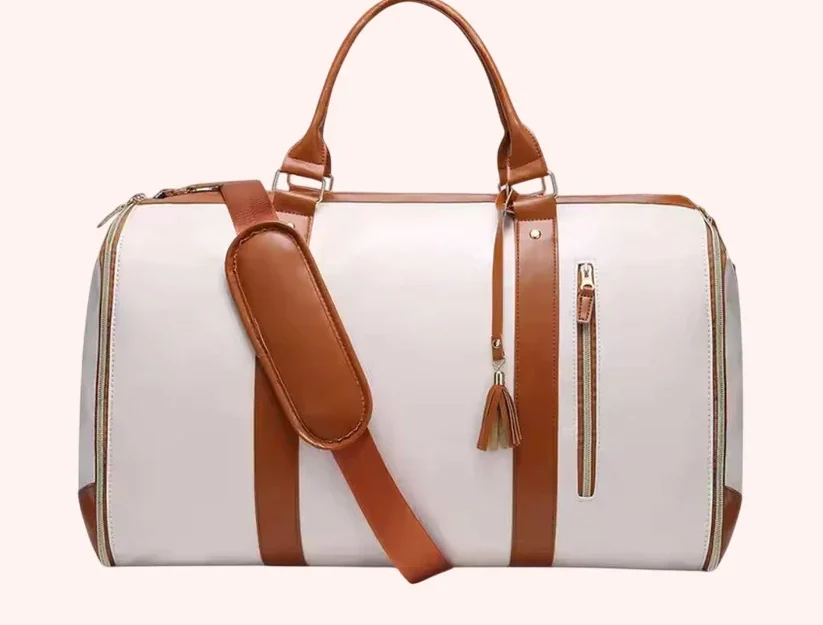
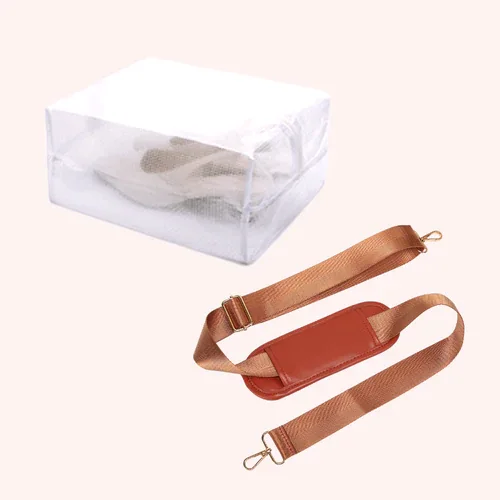
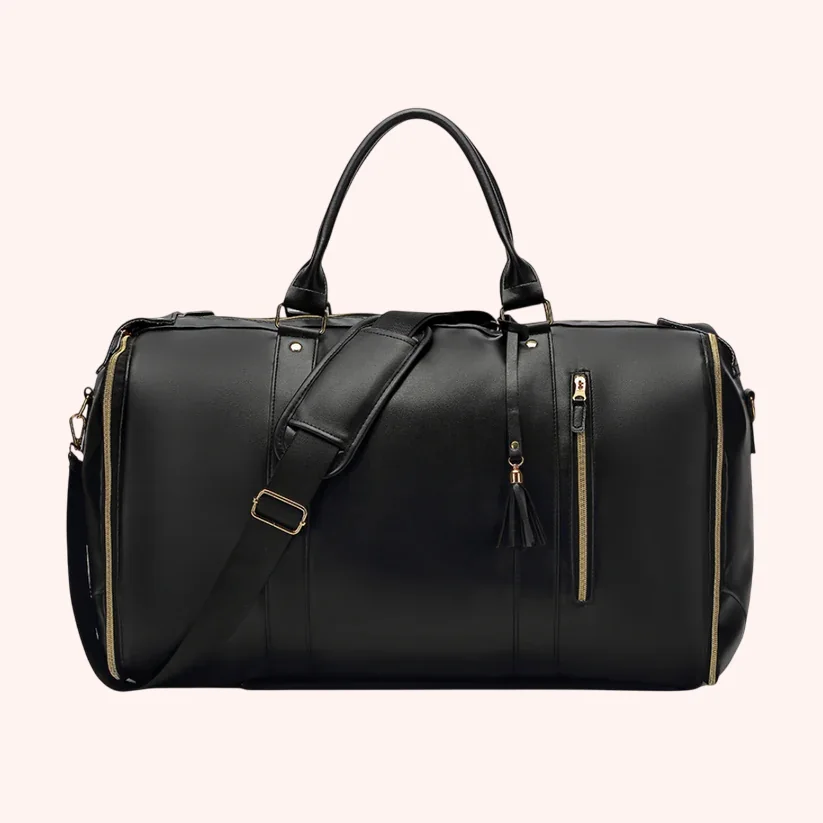
We designed the PristineBag Travel Duffel for that role. It has a trolley sleeve, and it opens flat into a garment bag for one suit or dress, so your event outfit travels in the cabin with you while the rest of your luggage goes in the hold. Shoes go in a separate compartment, and a front zip pocket holds your phone and passport.
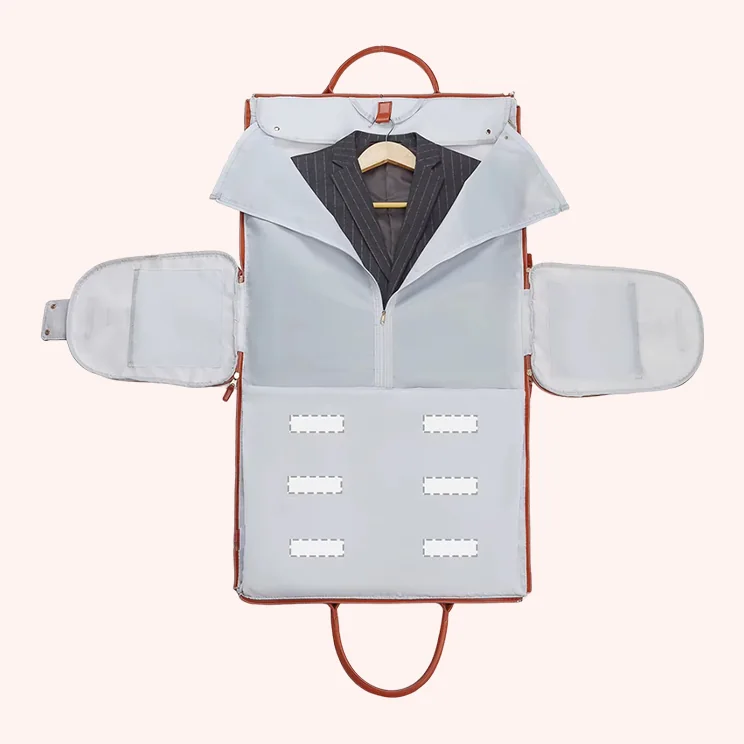
Be clear about its size. Packed full, the bag measures 20.5 × 12.5 × 10 in (52 × 32 × 25 cm), which is about 1 in deeper than the 9 in limit at American, Delta, United, Alaska and JetBlue. It fits Southwest and Frontier on paper. If you check a suitcase, you can pack the duffel lighter, and a soft bag that is not full compresses, though we have not measured how far. Check your airline before you go.
Carry-on check
Will the bag fit your airline?
Pick an airline to compare the bag, packed full, with its cabin bag limit.
Packed full, it is 2.5 cm over American Airlines’s limit. Carry-on limit: 55.9 × 35.6 × 22.9 cm.
What happens when a carry-on gets checked at the gate
Sometimes your carry-on bag becomes a checked bag at the last minute. It happens when the overhead bins are full, when the bag is over the size limit, or on small regional planes. American, for example, asks you to valet carry-on bags larger than its personal item size on many American Eagle flights; the bag is tagged at the gate and returned on the jet bridge, according to its carry-on page.
Before you hand it over, take out spare batteries, power banks, e-cigarettes, medication and valuables. This is the main reason to keep those items in your personal item from the start: they never have to move.
Carry-on and checked bag questions
Is it cheaper to carry on or check a bag?
On most standard US fares, the carry-on is included and the checked bag costs extra, so carrying on is cheaper. On some Basic Economy and budget fares, the carry-on also costs money, so compare both fees when you book.
What is the maximum weight for a checked bag?
In economy, 50 lb (23 kg) is common, as at Delta. Premium cabins often allow more, such as 70 lb in Delta One. Budget airlines can allow less, such as 40 lb at Frontier.
Can I put liquids over 3.4 oz in a checked bag?
Yes. The TSA tells travelers to pack containers larger than 3.4 oz (100 mL) in checked baggage. Seal them in a plastic bag in case of leaks.
Can power banks go in a checked bag?
No. The FAA requires spare lithium batteries and power banks to travel in carry-on baggage only, and to be removed if a carry-on is checked at the gate.
Can I check my carry-on bag for free?
Sometimes. When bins run out, airlines tag carry-ons at the gate, and American valets larger carry-ons on many regional flights at no charge. If you choose to hand it in at the counter, the normal checked bag fee applies.
Keep reading
More on carry-on rules